Unusual Suspects 

Game profile 

“Unusual Suspects” is a cooperative deduction game where investigators must identify a culprit through strategic questions and witness testimony. Originally published in 2015, this game develops communication skills, logical reasoning, and collaboration. Unlike the classic “Guess Who?”, which is competitive, “Unusual Suspects” requires players to work together, making the game particularly valuable for language and civic education.

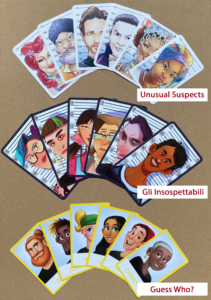
The original “Unusual Suspects” game is currently difficult to find. In 2022, a new version was released by the same author Paolo Mori, “Gli Insospettabili”, but it eliminates communication between players: players no longer read questions to the witness, but the witness takes 2 clue cards, chooses one, and shows it to the investigators. For this reason, I describe here the rules of the original game as they are more suitable for foreign language teaching. Alternatively, you can use “Guess Who?” cards to replicate the mechanics of “Unusual Suspects.”
Adaptation to Educational Context:

The game is useful for foreign language teaching for:

Practicing Vocabulary Related to Habits and Lifestyles – The game forces students to use vocabulary related to daily habits, lifestyles, family relationships, and leisure activities. The Witness must answer questions about the suspect’s habits, and the investigators must understand this information to eliminate characters.

Developing Collaborative Logical Reasoning in L2 – Unlike competitive games, students must discuss strategies, share hypotheses, and reach consensus entirely in the target language. This develops more complex and authentic communication skills.

Collaboration and Strategic Dialogue – Students must negotiate, propose strategies, and persuade teammates, developing advanced communication skills such as arguing, persuading, and mediating.

Civic Education: Recognizing Stereotypes – The game cards present characters with obvious stereotypical traits, offering the opportunity to discuss prejudices, categorizations, and cultural biases in a safe and playful context.

Language Practice:

Vocabulary: Daily habits, lifestyles, family relationships, leisure activities, professions, means of transportation, personal preferences, qualifying adjectives

Conversation: Question formulation, oral comprehension, strategic discussion, negotiation and argumentation

Grammar: The game can be used to practice grammar studied in class by removing the question cards and asking students to formulate their own questions.

Tips for Adapting to Class Level and Lesson Needs:

– Instead of using the original game cards, create themed cards related to the vocabulary studied in class.

For example, if you’re studying food, prepare cards with images of foods (tomatoes, pasta, apples, ice cream, etc.). Students draw a card and formulate questions using the target vocabulary: “Does he like tomatoes?”, “Did he eat tomatoes yesterday?”, “Can he cook tomatoes?”

If you want to practice verb structures, prepare cards with verbs that students must include in their questions (for example: work, study, read, go, relax, etc.) and ask students to formulate questions in the verb tense you want. For example, if you choose the past tense, possible questions would be: “Did he work at home yesterday?”, “Did he go to school yesterday?”, “Did he relax at the pool yesterday?”

– Introduce a rule where players can only eliminate one card at a time; this increases interaction intensity during the game. This eliminates the scoring based on the number of cards eliminated with one question.

– Remove the “Yes” and “No” cards and have the witness answer questions orally, giving complete answers: “Yes, he worked at home yesterday”, “No, he didn’t go to school yesterday.”

– After identifying the culprit, ask students to create a complete oral or written description of the character, remembering all the questions they asked. This text will be the starting point for discussing the stereotypes that emerged during the game.

– Debriefing on Stereotypes: At the end of the game, dedicate time to a guided discussion about the stereotypes that led the witness to answer questions and the investigators to guess the culprit.

Examples of Use in CLIL and Other Subjects:

For using the game mechanics in CLIL, see the description of the “Guess Who?” game.

Online Resources

Unusual Suspects on BGG

Gli insospettabili on BGG 

Piles! A Fast-Paced Free-For-All

Game profile 

“PILES!” is a dynamic and fast-paced card game where players compete to complete sets of four identical cards representing clothing items. To do this, they swap cards from their hands with the shared cards in the center of the table. The game combines speed, visual memory, and strategy, making each round an engaging and fun experience.

The game can be easily adapted for foreign language teaching by transforming the frantic game mechanism into a turn-based activity that requires constant verbalization. This makes it a valuable tool for practicing vocabulary and communication structures.


Game Rules for Foreign Language Lessons (EFL):

1.     The game is played in turns rather than simultaneously. This slows down the pace but allows for verbalization and reduces stress.

2.     Before starting the game, players study their own piles. On their turn, a player chooses ONE of their piles (without looking inside) and takes it in hand. Once taken, they must play with that pile. They exchange ONE card with a central card, describing the action: “I’m swapping this shirt for a skirt” or “I’m trading the yellow shirt for the red skirt.” Players need to remember which cards they have in their piles to make strategic choices.

3.     The turn passes to the next player clockwise.

4.     The first player to complete all their piles wins.

Adaptation to Educational Context:

The game is useful for foreign language teaching for:

Practicing Clothing Vocabulary – The game cards represent different clothing items in various colors. Each exchange requires verbalization of the objects, transforming the game into a natural and contextualized repetition exercise for clothing vocabulary.

Developing Oral Fluency – The need to describe each exchange (“I’m swapping this shirt for these socks”) develops linguistic automaticity and reduces processing time. Students practice repetitive syntactic structures in a meaningful context, increasing expressive fluency.

Strengthening Visual and Lexical Memory – The turn-based version transforms PILES! into a memory game: players must remember which cards they have in their face-down piles to plan exchanges. This connects the visual image of the cards to their verbal naming, reinforcing the form-meaning link.

Creating a Relaxed and Motivating Environment – The playful context reduces the performance anxiety typical of oral activities. Students focus on the game rather than on language production itself, communicating more naturally and spontaneously.

Language Practice:

Vocabulary: Clothing items, color adjectives, descriptions 

Grammar: Use of articles, demonstrative pronouns (this, that, these, those)

Conversation: Exchange structures, describing objects

Role-play: Cards can be used as a basis for communication simulations (e.g., shopping at a clothing store)

Tips for Adapting to Class Level and Lesson Needs:

– Start with 3 piles per person and simple description of the exchanged item: “I’m swapping this shirt for these socks.” Gradually increase to 6 piles as students gain confidence.

– For the next step, add adjectives: “I’m trading the yellow shirt for the red socks.”

– Post-game activity:

At the end of the game, each student describes the clothing items they have in their completed sets, expressing personal opinions:

Describe the items: “I have three shirts, two skirts, and one coat”

Express preferences: “I like this blue jacket” / “I don’t like these pants”

Comment on colors: “Pink looks good on me” / “Yellow isn’t my color”

Express intentions: “I’d like to try this skirt” / “I would never wear these socks”

– Debriefing

The debriefing moment is essential for consolidating learning and reflecting on the experience:

Linguistic reflection: discuss together the structures used, difficulties encountered in verbalization, and discovered communication strategies

– Error correction: address any errors noticed during the game without embarrassing students, proposing correct forms

Game feedback: ask students what they appreciated, what difficulties they encountered, and how they felt during the game

Examples of Use in CLIL and Other Subjects:

The added value of using “Piles!” in CLIL contexts is that students:

  1. Consolidate knowledge acquired during the year in a playful and engaging way
  2. Develop rapid visual recognition of subject content (artworks, cities, literary characters)
  3. Create connections between elements of the same category (works by the same artist, cities in the same country)
  4. Maintain high motivation thanks to the dynamic format and healthy competition

How to Use the Game in CLIL:

The mechanics of the original game (fast-paced and simultaneous version) can be used as an end-of-year activity for various subjects. In this context, the original rules are recommended to allow students to focus on the card content rather than verbalization during the game. Description and reflection on content take place during the post-game activity.

Literature

Game for reviewing books read during the year.

Card preparation:

– Create card sets with character names from all books read during the year

– Each set contains 4 characters from the same book

– It’s advisable to indicate on each card the book title and author’s name

Post-game activity:

Each student briefly recounts the books and characters present in their completed piles, refreshing the collective memory about the year’s readings and creating connections between different works.

Geography

Game to consolidate knowledge of countries and their cities.

Card preparation:

– Create card sets with 4 cities from the same country

– Each set represents a different country studied during the year

Post-game activity:

Each student chooses one of the countries present in their piles and prepares a brief presentation about that country (geographical features, culture, economy, interesting facts). This transforms the game into a starting point for personalised thematic exploration.

Art

Game to consolidate knowledge of artists and their works.

Card preparation:

– Create card sets with 4 works by the same artist studied during the year

– Each card contains: the artwork image, the work title, and the artist’s name

– Advantage: students who have studied will recognize works from the image without having to read and compare names, making the game faster and rewarding visual knowledge

Post-game activity:

Each student presents the works in their piles, describing the artist’s style, historical period, techniques used, and distinctive characteristics of the works. This allows reviewing and comparing different artists and art movements. 

Online Resources

Pilis! A Fast-Paced Free-For-All on BGG 

Guess Who? Card game 

Game profile 

“Guess Who?” is a classic game of deduction and logical reasoning, available in different versions: the classic version with boards, the travel version, and the new “Card Game” version. In this description, I focus on the “Card Game” version, particularly suitable for classroom use due to its practicality and quick setup.

The game mechanism develops various cognitive and linguistic skills: in addition to observation and logical reasoning abilities, students must formulate effective questions, use correct interrogative structures, and develop progressive elimination strategies. 

In an educational context, it can be used to practice descriptive vocabulary (especially physical appearance), strengthen listening and question comprehension skills, and enhance logical reasoning in a foreign language.


Adaptation to Educational Context:

The game is useful for foreign language teaching for:

Practicing Descriptive Vocabulary – The game forces students to use vocabulary related to physical characteristics, accessories, and colors. It is an ideal tool for practicing physical appearance description in a dynamic and engaging way.

Practicing Interrogative Structures – Students practice the correct formulation of closed questions (yes/no) and tag questions. 

Development of Logical Reasoning in L2 – Students must process information, eliminate possibilities, and formulate hypotheses entirely in the target language. This develops the ability to think directly in L2.

Active Listening Practice – Players must listen carefully to the opponent’s questions to give the correct answer (“yes” or “no”). This develops oral comprehension skills in an authentic and dynamic context.

Language Practice:

Vocabulary: Physical characteristics (hair, eyes, face), colors, sizes (tall/short, big/small), accessories (hat, glasses), qualifying adjectives.

Conversation: Formulation of closed questions, short answers (yes/no), oral comprehension.

Grammar: Interrogative structures (closed questions and tag questions).

Tips for Adapting to Class Level and Lesson Needs:

– The game is particularly useful for practicing physical description vocabulary. For lower levels, prepare a written list of useful adjectives and structures to keep visible during the game: hair colors (blonde, brown, black, red, gray), eye colors (blue, green, brown), characteristics (glasses, beard, mustache) and allow students to consult the vocabulary list during the game.

– To increase the number of questions and prolong the game: modify the elimination rule. Instead of flipping all characters that don’t match the answer, students can eliminate only one character at a time. This forces them to ask many more questions and practice the language more.

– Introduce a post-game reflection phase where students analyze the strategies used and the most effective questions, thus consolidating metalinguistic learning.

– Students can play in pairs (each pair receives a set of cards and plays independently) or in teams (with 2-3 people in a team).

Examples of Use in CLIL and Other Subjects:

The added value of using “Guess Who?” in CLIL contexts is that students:

1. Practice specialized subject vocabulary through targeted questions

2. Develop the ability to categorize and classify disciplinary elements

3. Reinforce basic knowledge in an interactive and memorable way

4. Use interrogative structures in authentic contexts related to the discipline

How to Use the Game in CLIL:

The mechanics of “Guess Who?” can be easily adapted to any subject by replacing characters with disciplinary elements. Teachers can create personalized cards with images and characteristics relevant to the study topic.

For CLIL subjects, it is recommended to create thematic card sets where each “character” represents an element of the discipline with specific characteristics.

Literature

Cards with names of characters from one or more novels studied in class. Students must guess the character by asking questions about their characteristics, actions, relationships with other characters.

Question examples: “The Picture of Dorian Gray” by Oscar Wilde

– Is this character an artist?

– Does this character influence Dorian negatively?

– Is this character in love with Dorian?

Art History

Cards with reproductions of famous artworks. Students must guess the work by asking questions about style, author, period, predominant colors, subjects represented.

Question examples:

– Is this artwork from the Renaissance?

– Is the artist American?

– Are there human figures in the artwork?

– Is it a portrait?

Geography

Cards with images and names of countries or flags. Students must guess by asking questions about continents, territorial characteristics (mountains, rivers, seas), climate, population, main resources.

Question examples:

– Is this country located in Europe?

– Does it have access to the ocean?

– Are there mountains in this country?

Science

Cards with images of animals or plants. Students ask questions about characteristics: class (mammal, reptile, bird, etc.), habitat, diet, distinctive physical features.

Question examples for animals:

– Is it a mammal?

– Does it live in water?

– Does it have feathers?

– Can it fly?

Yes or No 

Game profile 

“Yes or No” is a communication game where players must answer questions while avoiding specific “forbidden” words, primarily “yes” and “no.” The mechanism, seemingly simple, conceals a deep communicative challenge: it forces players to constantly reformulate their answers, developing linguistic flexibility and argumentative skills. This characteristic makes it particularly valuable for teaching foreign languages, where students often tend to give excessively brief responses.

The game can be adapted to any language level by modifying the complexity of questions, the number of forbidden words, and the time allowed to respond.

In an educational context, it can be used to develop expressive fluency, prepare for oral exams, expand active vocabulary, and strengthen the ability to argue in a foreign language.

Adaptation to the educational context:

The game is useful for foreign language teaching for:

Oral exam preparation – Many language certification exams penalize responses that are too brief. The game trains students to elaborate their answers, developing the habit of providing detailed explanations and complete arguments.

Active vocabulary expansion – The need to avoid specific words pushes students to use synonyms, paraphrasing, and alternative linguistic structures, transforming passive vocabulary into usable active competence.

Development of alternative communication strategies – Students are forced to find creative ways to express concepts when direct answers are forbidden. This develops communicative flexibility and linguistic problem-solving skills, essential for advanced communicative competence.

Reduction of performance anxiety – The playful context allows students to practice elaborate responses in a relaxed environment, reducing the pressure typical of exam situations and developing confidence in their expressive abilities.

Language Practice

Vocabulary: Synonyms, antonyms, paraphrasing, alternative expressions, logical connectors

Conversation: Argumentation, elaboration of thought, active listening

Storytelling: Narrative skills, detailed descriptions

Tips for adapting the game to the class level and lesson needs:

– For A1-A2 levels, limit forbidden words to “yes,” “no” and focus on simple questions about daily life, requiring answers of at least two complete sentences. For higher levels, add other forbidden words like “maybe,” “good,” “bad” and introduce questions requiring personal opinions and justifications, simulating typical certification exam situations.

– Introduce a post-game reflection phase where students analyze the communication strategies used and the linguistic alternatives discovered.

– Create thematic sessions using only questions related to a specific topic (for example, travel, technology, environment) to consolidate learned vocabulary.

– Use the game as a warm-up by introducing only 2-3 cards per session or asking just one question per person.

Examples of use in CLIL and other subjects:

The added value of using “Yes or No” in CLIL contexts is that students:

  1. Practice subject-specific vocabulary in a dynamic and engaging way
  2. Develop automatisms in recognizing and using disciplinary terminology
  3. Reinforce basic knowledge through factual questions requiring linguistic reworking
  4. Maintain high motivation thanks to the speed and playful format of the game

How to use the game in CLIL:

For CLIL subjects, it is recommended to use simple and factual questions that verify acquired basic knowledge. Questions must be direct and require short (2-3 sentences) but elaborated answers, avoiding forbidden words.

To earn a point, the answer must satisfy two requirements: not contain forbidden words and be correct in terms of subject content.

Other players will check both these aspects before awarding the point.To ensure the game remains a game and players maintain “flow,” the teacher should not intervene during the game even if the answer accepted by other players is wrong. The most effective strategy in this case is to note the error and discuss it during the debriefing moment.

The game can be played in teams of 3-5 people, in quiz format. Each team must have a table bell. The teacher reads questions one at a time. The first team to ring the bell has the right to answer. If the answer avoids forbidden words and is correct in content, the team earns a point. If the answer contains forbidden words or content errors, other teams must ring their bell and give the correct answer.

Mathematics

Questions about mathematical properties, geometry, and basic operations.

For beginner levels (A1), simple arithmetic operations can be used that force reformulation of the answer.

Example

Question: Seven minus two equals five? 

Correct answer: Seven minus two equals five / The result is five.

Other example questions: Does a triangle have four sides? Is pi equal to 3.14? Does a square have all sides equal?

History

Questions about dates, events, historical figures, and places. Students must confirm or correct the information without using forbidden words.

Example

Question: Was George Washington the first US president?

Possible answer: George Washington served as the first president of the United States from 1789 to 1797.

Other example questions: Did World War I start in 1914? Did Christopher Columbus discover America? 

Science

Questions about classifications, natural processes, physical properties, and characteristics of organisms.

Example

Question: Does the Moon produce its own light?

Possible answer: The Moon reflects the light of the Sun. It doesn’t have its own light like stars do.

Other example questions: Does water boil at 100 degrees Celsius? Are humans mammals? 

Geography

Questions about territorial characteristics, capitals, rivers, mountains.

Example

Question: Are there 50 states in the United States?

Possible answer: The United States consists of fifty states.

Other example questions: Is the Mississippi the longest river in the US? Is London the capital of the United Kingdom?

Literature

Questions about authors, works, literary periods.

Example

Question: Did Shakespeare write Romeo and Juliet?

Possible answer: William Shakespeare is the author of Romeo and Juliet, one of his most famous tragedies.

Other example questions: Was Romeo in love with Juliet? Was Mark Twain a 19th-century author? 

Art

Questions about artists, works, artistic movements, and techniques.

Example

Question: Was Picasso an Impressionist painter?

Possible answer: Picasso is considered the founder of Cubism, not part of the Impressionist movement.

Other example questions: Did Leonardo da Vinci paint the Mona Lisa? Did Michelangelo sculpt the David? Was Andy Warhol associated with Pop Art?

Top Trumps

Game profile

Top Trumps is a classic competitive card game where each card represents a specific element (cars, animals, superheroes, monuments, etc.) accompanied by various numerical statistics. The game mechanism is simple: players compare the numerical values of their cards to determine who wins each round. The characteristic that makes this game particularly suitable for language teaching is the constant need to read, compare, and comment on numerical data, naturally stimulating the use of comparative and superlative structures.

Different games with Top Trumps mechanics exist, such as Top Trump Battle Mat or Mini Match. In this article, I focus on the game with classic rules because it’s more suitable for a foreign language class.

Another interesting version to use in class is Top Trump Quiz. For example, in English there’s the “Countries and Flags” game with 500 geographical, historical, and cultural questions, which combines the card mechanism with quiz elements, offering additional opportunities for language practice and knowledge expansion.

Many thematic versions of Top Trumps exist: from sports cars to wild animals, from world monuments to historical figures, allowing the game to be adapted to any curriculum or student interest.

In an educational context, it can be used to reinforce comparative structures, practice numbers and units of measurement, expand specialised vocabulary, and develop argumentative skills.

Adaptation to the educational context:

The game is useful for foreign language teaching because of:

Intensive practice of comparatives – Every game turn necessarily requires the use of comparative structures (“taller than,” “less fast than,” “the biggest”), making this grammatical practice natural and motivated by the playful context.

Acquisition of specialized numerical vocabulary – Students must correctly read and pronounce complex numbers, units of measurement, percentages, and statistics, developing essential skills for scientific and professional communication.

Learning specialized vocabulary in context – Each thematic deck introduces a specific lexical field (automotive, zoological, geographical) that is assimilated through repeated and meaningful use during the game.

Language practice:

Vocabulary: Specialized vocabulary of the chosen theme, numerals, units of measurement, descriptive adjectives

Grammar: Comparatives and superlatives, comparison structures (“while,” “instead,” “unlike”), quantity expressions

Conversation: Argumentation of strategic choices, discussion of data, expression of surprise or disappointment

Storytelling: Description of element characteristics, creation of narrative contexts

Tips for adapting the game to the class level and lesson needs:

– For more advanced levels, require comments on results using expressions of surprise (“I didn’t expect that…,” “It’s incredible that…”).

– Modify traditional rules by allowing group discussions before revealing values, encouraging collaborative negotiation and argumentation.

– After each turn, compare all card statistics. Ask students to vote for the best one (e.g., if playing with world countries, choose which country they would like to visit) and explain their choice.

– Use the game as a warm-up by introducing only 5-6 cards per session, focusing on the quality of linguistic interaction rather than game duration.

– Integrate follow-up activities where students create their own Top Trumps cards on curricular topics, thus developing research and synthesis skills.

Examples of use in CLIL and other subjects:

1. Learn to use numerical data and statistics in the foreign language

2. Acquire automatisms in using comparative structures essential for scientific communication

3. Develop argumentative and problem-solving strategies in an authentic linguistic context

4. Consolidate disciplinary knowledge through systematic comparison of information

The game mechanics are particularly well-suited to subjects where it’s important to develop comparative and analytical skills through quantitative data.

Geography

Use decks with world countries, cities, mountains, rivers, or monuments. Statistics can include altitude, population, surface area, average temperatures.

For monuments, compare height, year of construction, annual number of visitors, simultaneously developing cultural knowledge and comparative skills.

Natural Sciences

Animal decks allow comparison of weight, speed, life expectancy, habitat. Students practice not only comparatives but also scientific vocabulary: “The cheetah is faster than the lion, but the lion is heavier than the cheetah.”

For plants, compare height, longevity, geographical distribution, developing botanical knowledge and descriptive skills.

History

Create cards with historical figures, comparing birth and death years, reign duration, number of battles won, etc. Students develop comparative chronologies: “Napoleon lived longer than Alexander the Great, but ruled for less time.”

Alternatives include historical events with duration, number of participants, measurable consequences.

Chemistry

Chemical elements with atomic number, atomic weight, melting point. Students compare properties while assimilating scientific terminology: “Iron has a higher melting point than lead.”

Literature

Create cards with famous writers comparing birth and death years, number of published works, foreign language translations, literary prizes won. Students develop literary chronologies: “Shakespeare lived less than Goethe, but his works have been translated into more languages.”

An interesting alternative is comparing works by a single author: number of pages, publication year, sales, film adaptations.

Online resources

On the Top Trumps website you can discover all game versions.

Dobble/ Spot it

Game profile

Dobble is a popular observation and speed game consisting of round cards featuring various symbols. The unique characteristic of this game is that between any pair of cards, there is always one and only one symbol in common. Players must be the first to identify this common symbol to win the cards. The game stimulates observation skills, reflexes, and rapid recognition abilities, making it an excellent game for both entertainment and learning.

Several versions of the game exist: from classic Dobble with various symbols, to Dobble 1 2 3 with shapes and numbers (perfect for learning numbers and colours), to Dobble Access + and Dobble Giant, which adds a movement component to lessons and is particularly suitable for physically engaging students.

In an educational context, Dobble can be used to reinforce vocabulary, improve pronunciation, and develop quick response abilities in a foreign language.

Adaptation to the educational context:

The game is useful for foreign language teaching because of:

Immediate lexical acquisition – Students must quickly identify and pronounce words in the target language. This need for immediate response reinforces memorization and develops linguistic automatism, essential for fluency.

Natural and motivating repetition – The game mechanics create spontaneous vocabulary repetition without students perceiving the exercise as boring or repetitive. The playful element maintains high motivation.

Effective visual association – The direct connection between image and word facilitates memorisation and lexical recall, creating lasting mental connections.

Language anxiety reduction – The playful aspect and concentration required by the game reduce the anxiety that often accompanies foreign language use.

Language practice:

Vocabulary: Any semantic field, from the alphabet to specialized vocabulary

Grammar: Sentence formation, article usage

Storytelling: Narrative creation using identified elements

Tips for adapting the game to the class level and lesson needs:

– Suitable for all language levels: can be used from the first lesson, with the alphabet for absolute beginners, up to specialized vocabulary for advanced levels.

– Create personalized cards with both images and words in the target language, allowing different difficulty levels within the same class.

– Modify basic rules by requiring not only naming the found word, but creating a complete sentence with that word to earn the card or an extra point.

– For concrete objects, invite students to describe the identified object and explain what we use it for, thus developing descriptive and functional skills.

– During the game, ask students to write down all the words they name. During a follow-up activity, students must create a coherent text using these words. For each game word actually used in the text, add a point to the final score.

– For advanced levels, require the addition of antonyms, synonyms, or detailed descriptions of events or concepts for certain terms, thus expanding lexical and semantic work.

– Use larger game versions (Dobble Giant) for movement activities in class, combining language learning with physical engagement.

– In class, cards can also be presented on an interactive whiteboard. Students divided into small groups must find similar objects and/or words. In this case, it’s useful to give each group a bell they must ring when they find the answer.

Examples of use in CLIL and other subjects:

The added value of using Dobble is that students:

1. Acquire subject-specific vocabulary naturally and enjoyably

2. Develop automatisms in recognizing and using specific terms

3. Use the foreign language in an authentic and motivating context

4. Simultaneously strengthen disciplinary knowledge and language skills

The game mechanics could be used in various subjects to increase specific vocabulary and where it’s important to develop speed in recognizing this vocabulary.

It’s recommended to invite students not only to name objects, but to add some description useful for learning.

For example, in a geography lesson, cards can be created with countries, capitals, and flags. Students could add characteristics like climate, language, resources, etc.

In biology lessons, cards are created with parts of the human body and organs. For the heart, students could give a characteristic like “The heart pumps blood throughout the body.”

Online resources

On the dobblegame.com website you can discover more about this game.

On the Asmodee website you’ll find the game rules.

If you want to download a demo kit and activities based on the game, you can do so in Asmodee’s “Print and play” section.

To try the game online, use the Board Game Arena website.

On the Genially website there’s a ready template for creating a quick online game.

There are also various “Dobble-like generators.” They’re not official, but they use the original game’s algorithms (it’s not so simple to create cards where, given any pair, there’s only one common element!) to create cards. I like this website, where you just need to upload images of the words you need and the site creates the cards, automatically calculating the number of images on each card and the possible number of cards. You can then download the result in PDF format.

Timeline Twist 

Game profile 

The first famous game in this series was Timeline, which stimulates historical knowledge, sequential thinking, and collaborative abilities, making it an excellent game both for entertainment and learning. However, in the educational context, in my opinion, the rules of the new edition – Timeline Twist – are more suitable. The main difference compared to classic Timeline is the collaborative aspect, where players can communicate and advise each other to achieve the best possible score as a team. This is why the article is dedicated to the Timeline Twist game.

In an educational context, it can be used to strengthen interdisciplinary skills, encourage discussion and negotiation, and improve teamwork.

The variety of topics allows this game to be used with students with different interests: from classic Timeline to Timeline Inventions, Timeline Twist Star Wars o Timeline Twist Pop Culture. 

Adaptation to the educational context:

The game is useful for teaching foreign languages for:

Lexical development in context – Students acquire and practise specific vocabulary related to historical events, inventions, and discoveries in the target language. This contextualised learning makes vocabulary acquisition more meaningful and memorable.

Authentic communicative practice – During the game, students must discuss, argue, and negotiate in the foreign language to decide where to place the cards. This communication has a real and immediate purpose, making language practice authentic.

Reduction of language anxiety – The playful and collaborative aspect of the game reduces the anxiety that often accompanies communication in a foreign language. Students focus on the task (correctly positioning the cards) rather than worrying about language errors.

Language practice:

Vocabulary: Historical, scientific, or cultural vocabulary, numerals (dates)

Grammar: Temporal prepositions, past tenses, passive voice (For example: “The battery was invented in 1880 by Alessandro Volta”, “This happened before/after…”), hypotheses (“I believe it happened around…”), and justifying one’s choices (“I think it goes here because…”).

Conversation: Discussion about events and their sequence

Storytelling: Narrative reconstruction of historical periods

Tips for adapting the game to the class level and lesson needs:

– In the rules, specify that all discussions between teammates must take place in the language they are learning. To help them follow this rule, penalties can be introduced: for example, if a student does not speak in the language being studied, they must discard one of their cards, which prevents the team from creating a longer timeline and, when calculating points, subtracts a point from the score achieved.

– It’s possible to remove the discard option from the rules: students will pay more attention to events and dates. It doesn’t affect the score, because both the discarded card and the incorrect card that the player keeps are worth -1 point.

– The number of players is up to 6, so for a class, teams can be created: 

divide the group into teams of maximum 6 people who compete against each other to create a longer timeline and accumulate more points, or create a team of 12 students, which will play in 6 groups. Two students play for one group.

– Include a debriefing phase where new words or expressions encountered are discussed.

Examples of use in CLIL and other subjects:

The added value of using Timeline Twist is that students:

1. Learn the specific vocabulary of the discipline in context

2. Strengthen understanding of temporal sequences and cause-effect relationships

3. Use the language in an authentic, collaborative, and motivating context

4. Develop critical thinking and estimation skills

History

The game is perfect for history class. Students learn to place events in chronological order in a playful context and are encouraged to remember the historical sequence to get a good score.

To use it in class, you need to choose the game cards or create customised cards appropriate to the class’s history curriculum.

It is advisable to start with one historical period and add other periods later.

After the timeline is ready, ask students to present it, briefly describing each card. This could be done right after the game, or as a group assignment to present later.

The game mechanics could also be used for other subjects where there is a sequence of events.

In this case, customised cards need to be created. Here are some examples:

Science

Evolution and scientific discoveries:

Create a set of cards with scientific discoveries (for example: THEORY OF EVOLUTION, DISCOVERY OF DNA, PERIODIC TABLE, NEWTON’S LAWS, DISCOVERY OF ANTIBIOTICS, MAPPING OF THE HUMAN GENOME)

Students collaborate to correctly position these discoveries on the timeline.

Periodic table

Create a set of cards of the most relevant elements for the curriculum. Each card should have on the front: name of the element, chemical symbol, main use; on the back: atomic weight, electronegativity, melting point (or other relevant properties). Decide the property to order, for example, atomic weight.

Students collaborate to order the elements from lightest to heaviest (for example: H (1.0) – O (16.0) – Fe (55.8) – Cu (63.5) – Au (197.0)).

During the game student can refer to the periodic table.

Literature

Cards with literary works, authors, or movements from English-language literature (for example: CANTERBURY TALES, SHAKESPEARE’S PLAYS, PRIDE AND PREJUDICE, ROMANTICISM, VICTORIAN NOVEL, MODERNISM, THE GREAT GATSBY, BEAT GENERATION, HARRY POTTER)

Students collaborate to create a timeline of English literature.

To help students place authors in the correct historical period, and, as a result, understand them better, it is advisable to combine cards with major historical events and literary ones.

Art

Cards with artistic movements or famous works (for example: RENAISSANCE, IMPRESSIONISM, CUBISM, POP ART, BRITISH PORTRAITURE, DIGITAL ART)

Students must place them in chronological order, discussing characteristics and historical context.

In French, there is a version of the game called Timeline Louvre.

Philosophy

Evolution of philosophical thought:

Create a set of cards with relevant philosophers and philosophical movements. (for example: SOCRATES, PLATO, ARISTOTLE, ANALYTIC PHILOSOPHY)

Students collaborate to correctly position these philosophers and schools of thought on the timeline.

After the students have completed the timeline, ask them to present it by briefly explaining a key concept or fundamental idea of the philosophers. One point is added for each card that is correctly explained.

It is advisable to create cards that include, in addition to the philosopher’s name, a representative quote or key concept, thus facilitating the connection between the thinker and their ideas.

Online resources

On the Asmodee website, you can download the game demo with examples of cards and an activity for history lessons.

Timeline Twist can be played online on Board Game Arena. 

Dixit

Game profile 

Dixit is an excellent game for stimulating creativity and linguistic expression. In a language learning context, it can be used to practise description, the use of metaphors and similes, and to expand vocabulary in a creative way. Its surreal illustrations offer endless possibilities for interpretation, making each game unique. The game also encourages active listening and understanding of linguistic nuances, making it useful for students of various levels. It can be easily adapted to focus on specific linguistic or thematic aspects, depending on the educational objectives.

Adaptation to the educational context:

The game is useful for teaching foreign languages for several reasons:

Stimulates linguistic production – Students must create sentences, descriptions, or stories based on images, exercising vocabulary and grammatical structures.

Develops communication skills – Players must express themselves clearly but creatively, finding the right balance to make themselves understood without being too obvious.

Enriches vocabulary – Dixit’s surreal illustrations often require the use of descriptive adjectives, metaphors, and similes, expanding students’ lexicon.

Promotes active listening – To guess the right card, students must listen carefully and understand the clues from others.

Breaks down language anxiety barriers – Being a game, it creates a relaxed atmosphere where it’s easier to express oneself without fear of making mistakes.

Tips for adapting the game to the class level and lesson needs:

– With the original game rules:

Vocabulary

Students must describe the card with just one word

Grammar

Students must use the structures proposed by the teacher to describe the card.

Example: Past tense practice (A2)

Students use past simple and perfect tenses to describe “what happened” in the card.

Expression of hypotheses (B1)

Students describe the card using conditional sentences to express “what would happen if…”

– Changing the rules:

Storytelling 1

Cards can be used to create stories.

For example, create a common story based on one card, adding one sentence at a time. Or create a story with different cards. Students take 2-3 cards (increasing the number of cards as students become more familiar with telling stories this way) and place them in front of themselves. The first student starts by placing one of their cards in the middle of the table and saying a sentence to begin the story. The second student chooses a card, places it after the first student’s card, and continues the story. The last card must close the story.

Storytelling 2

Each student receives a card that they don’t show to anyone and creates a story. Then all the cards are collected, and the same number of new cards, not used by students, are added. All cards are placed in the middle, visible to all students. Each student tells their story and the others must guess their card. Whoever guesses correctly gets a point.

Conversation (questions and answers) and grammar

Investigation and deduction game.

Place the cards in front of the students so that each student can see them. Each student takes turns playing by choosing a card, but does not say which card they have chosen. The other students must ask questions which the player must answer. Initially, the questions can be direct, e.g., “Is there a person on the card?” and later more abstract and using more complex structures, e.g., “What do you think about when you look at this image?”, “If this image were a season, which would it be?”.

Students must guess the card or each time remove one card that they think does not correspond to the answers: in the end, the right card remains. If they have guessed correctly, the team that guesses wins. If they were wrong, the student who chose the card wins.

Examples of use in CLIL and other subjects:

Literature

Analysis of characters, setting, and atmosphere of a literary work.

Prepare cards with descriptions of characters, monologues, dialogues, descriptions of places from the book you are reading.

Distribute 6 Dixit cards to each player, as in the original rules. One student at a time takes a description and reads it aloud. Each student chooses a card from among those they have that represents the text read. Then all the cards are shuffled and revealed. Students vote for the best card (they cannot vote for their own card). The student who used the card that collected the most votes gets a point. 

Then each student explains their choice, connecting visual elements of the card to textual aspects.

Philosophy

The images of the game allow visualising abstract notions and making them more accessible.

Before the game, prepare cards with key concepts, for example: utilitarianism, pragmatism, empiricism etc. 

Distribute 6 Dixit cards to each player, as in the original rules. During the game, students take one card with a concept and each student chooses a card from those they have that best represents the concept. Students vote for the best card (they cannot vote for their own card). The student who used the card that collected the most votes gets a point.

Then each student presents and justifies their choice using appropriate philosophical terminology.

Online resources

On the Asmodee website, you can download the game demo with examples of Dixit cards with the rules to print at home.

On the Boardgame Arena website, you can play Dixit online. 

Codenames

Game profile 

Codenames stimulates creativity, associative thinking, and communication skills, making it an excellent game both for entertainment and for language training, particularly for vocabulary expansion and understanding relationships between words. In an educational context, it can be used to strengthen language skills, encourage discussion and argumentation, and improve group communication.

It is possible to choose for the lessons from: Codenames, Codenames Pictures and Codenames XXL (with large cards to not exclude anyone).

Adaptation to the educational context:

It is particularly useful in foreign language classes because it helps:

Vocabulary development – Students learn new words in a playful context and are incentivised to remember meanings to win.

Semantic associations – The game requires creating connections between words, strengthening the understanding of semantic relationships in the target language.

Active communication – Players must express themselves in the language they are learning, thus practising active use of the language.

Motivation – The competitive and fun element increases motivation and reduces the anxiety that often accompanies language learning.

Thinking in a foreign language – To play effectively, students must begin to “think” in the language they are learning rather than continuously translating.

Tips for adapting the game to the class level and lesson needs:

– Create custom cards appropriate to the students’ level

– In the rules, specify that all discussions between players must take place in the language they are learning. To help them follow this rule, penalties can be introduced: for example, if a team speaks in a language other than the one being studied, the opposing team’s spymaster can reveal one of their own words, thus facilitating the victory of their team.

– If necessary, change the rules; for example, instead of a word, it’s possible to say a phrase.

– Proceed step by step. Initially teach the game using simple words and do a trial of the game with these words. Then, use the words that are needed.

– At the end of each game, ask the teams to create a story (written or oral) using the words of the team agents. If necessary, indicate the time in which to tell the story or add other instructions based on the grammar studied.

Examples of use in CLIL and other subjects:

The added value of using Codenames is that students:

  1. Learn specific vocabulary of the discipline
  2. Strengthen theoretical connections between content
  3. Use the foreign language in an authentic and motivating context
  4. Develop critical thinking and categorisation skills

Science

Periodic table

– Cards with chemical elements (for example: OXYGEN, IRON, HYDROGEN, COPPER, NITROGEN, SODIUM, CARBON, SILVER, CHLORINE, HELIUM, CALCIUM, MERCURY, PHOSPHORUS, GOLD, ALUMINIUM, SOLID, LIQUID, GAS, ATOM, ACID, REACTION, ORGANIC, NEUTRON)

– Spymaster gives clues related to chemical properties, groups, or applications

– Examples of clues: “METAL 3” to connect IRON, COPPER and ALUMINIUM

“STATE 3” to connect SOLID, LIQUID and GAS

Terms such as SOLID, LIQUID, GAS, ATOM, ELECTRON could also be included

Art

– Cards with artists, techniques or styles (for example: TURNER, IMPRESSIONISM, WATERCOLOUR, BANKSY, RENAISSANCE, ABSTRACT, PORTRAIT, PERSPECTIVE, WARHOL, CUBISM)

– Examples of clues: “BRITISH 2” to connect TURNER and BANKSY

“TECHNIQUE 2” to connect PORTRAIT and WATERCOLOUR

History

– Cards with historical events and names of characters (for example: CHURCHILL, INDUSTRIAL REVOLUTION, VICTORIAN ERA, COLONY, DEMOCRACY, TUDOR, CIVIL WAR, PARLIAMENT, MARTIN LUTHER KING, DECLARATION OF INDEPENDENCE, WORLD WAR, WASHINGTON, SUFFRAGETTES, ROOSEVELT, COLD WAR)

– Example of clue: “FREEDOM 2” could connect DECLARATION OF INDEPENDENCE and SUFFRAGETTES

Geography

– Cards with countries, capitals, geographical places (for example: BRITAIN, EVEREST, GRAND CANYON, LONDON, MISSISSIPPI, DESERT, NEW YORK, EQUATOR, ROCKIES, THAMES)

– Example of clue: “RIVERS 2” to connect MISSISSIPPI and THAMES

Literature

– Cards with writers, styles or book characters (for example: DICKENS, NOVEL, HAMLET, SHAKESPEARE, GATSBY, JANE EYRE, PROLOGUE, AUSTEN, TRAGEDY, HEMINGWAY, TO KILL A MOCKINGBIRD)

– Examples of clues: “CLASSIC AUTHORS 3” to connect SHAKESPEARE, DICKENS and AUSTEN

Online resources

On the website http://codenames.game you can create online games with the vocabulary you need.