
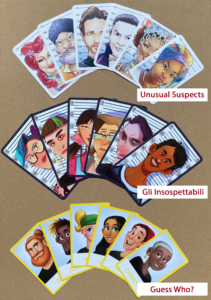
“Unusual Suspects” is a cooperative deduction game where investigators must identify a culprit through strategic questions and witness testimony. Originally published in 2015, this game develops communication skills, logical reasoning, and collaboration. Unlike the classic “Guess Who?”, which is competitive, “Unusual Suspects” requires players to work together, making the game particularly valuable for language and civic education.

The original “Unusual Suspects” game is currently difficult to find. In 2022, a new version was released by the same author Paolo Mori, “Gli Insospettabili”, but it eliminates communication between players: players no longer read questions to the witness, but the witness takes 2 clue cards, chooses one, and shows it to the investigators. For this reason, I describe here the rules of the original game as they are more suitable for foreign language teaching. Alternatively, you can use “Guess Who?” cards to replicate the mechanics of “Unusual Suspects.”
Adaptation to Educational Context:
The game is useful for foreign language teaching for:
Practicing Vocabulary Related to Habits and Lifestyles – The game forces students to use vocabulary related to daily habits, lifestyles, family relationships, and leisure activities. The Witness must answer questions about the suspect’s habits, and the investigators must understand this information to eliminate characters.
Developing Collaborative Logical Reasoning in L2 – Unlike competitive games, students must discuss strategies, share hypotheses, and reach consensus entirely in the target language. This develops more complex and authentic communication skills.
Collaboration and Strategic Dialogue – Students must negotiate, propose strategies, and persuade teammates, developing advanced communication skills such as arguing, persuading, and mediating.
Civic Education: Recognizing Stereotypes – The game cards present characters with obvious stereotypical traits, offering the opportunity to discuss prejudices, categorizations, and cultural biases in a safe and playful context.
Language Practice:
Vocabulary: Daily habits, lifestyles, family relationships, leisure activities, professions, means of transportation, personal preferences, qualifying adjectives
Conversation: Question formulation, oral comprehension, strategic discussion, negotiation and argumentation
Grammar: The game can be used to practice grammar studied in class by removing the question cards and asking students to formulate their own questions.
Tips for Adapting to Class Level and Lesson Needs:
– Instead of using the original game cards, create themed cards related to the vocabulary studied in class.
For example, if you’re studying food, prepare cards with images of foods (tomatoes, pasta, apples, ice cream, etc.). Students draw a card and formulate questions using the target vocabulary: “Does he like tomatoes?”, “Did he eat tomatoes yesterday?”, “Can he cook tomatoes?”
If you want to practice verb structures, prepare cards with verbs that students must include in their questions (for example: work, study, read, go, relax, etc.) and ask students to formulate questions in the verb tense you want. For example, if you choose the past tense, possible questions would be: “Did he work at home yesterday?”, “Did he go to school yesterday?”, “Did he relax at the pool yesterday?”
– Introduce a rule where players can only eliminate one card at a time; this increases interaction intensity during the game. This eliminates the scoring based on the number of cards eliminated with one question.
– Remove the “Yes” and “No” cards and have the witness answer questions orally, giving complete answers: “Yes, he worked at home yesterday”, “No, he didn’t go to school yesterday.”
– After identifying the culprit, ask students to create a complete oral or written description of the character, remembering all the questions they asked. This text will be the starting point for discussing the stereotypes that emerged during the game.
– Debriefing on Stereotypes: At the end of the game, dedicate time to a guided discussion about the stereotypes that led the witness to answer questions and the investigators to guess the culprit.
Examples of Use in CLIL and Other Subjects:
For using the game mechanics in CLIL, see the description of the “Guess Who?” game.
Online Resources
“Unusual Suspects” on BGG
“Gli insospettabili” on BGG