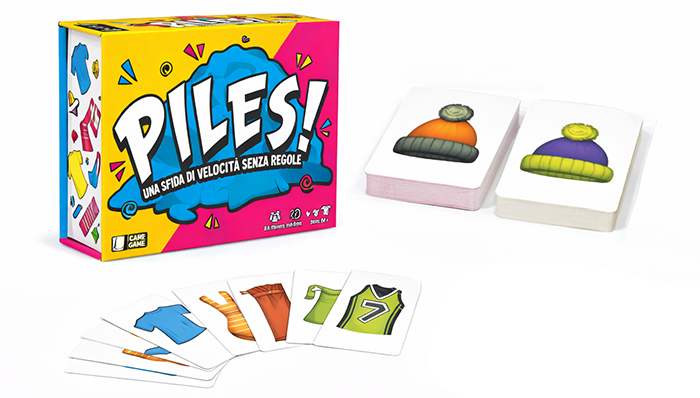
“PILES!” is a dynamic and fast-paced card game where players compete to complete sets of four identical cards representing clothing items. To do this, they swap cards from their hands with the shared cards in the center of the table. The game combines speed, visual memory, and strategy, making each round an engaging and fun experience.
The game can be easily adapted for foreign language teaching by transforming the frantic game mechanism into a turn-based activity that requires constant verbalization. This makes it a valuable tool for practicing vocabulary and communication structures.
Game Rules for Foreign Language Lessons (EFL):
1. The game is played in turns rather than simultaneously. This slows down the pace but allows for verbalization and reduces stress.
2. Before starting the game, players study their own piles. On their turn, a player chooses ONE of their piles (without looking inside) and takes it in hand. Once taken, they must play with that pile. They exchange ONE card with a central card, describing the action: “I’m swapping this shirt for a skirt” or “I’m trading the yellow shirt for the red skirt.” Players need to remember which cards they have in their piles to make strategic choices.
3. The turn passes to the next player clockwise.
4. The first player to complete all their piles wins.
Adaptation to Educational Context:
The game is useful for foreign language teaching for:
Practicing Clothing Vocabulary – The game cards represent different clothing items in various colors. Each exchange requires verbalization of the objects, transforming the game into a natural and contextualized repetition exercise for clothing vocabulary.
Developing Oral Fluency – The need to describe each exchange (“I’m swapping this shirt for these socks”) develops linguistic automaticity and reduces processing time. Students practice repetitive syntactic structures in a meaningful context, increasing expressive fluency.
Strengthening Visual and Lexical Memory – The turn-based version transforms PILES! into a memory game: players must remember which cards they have in their face-down piles to plan exchanges. This connects the visual image of the cards to their verbal naming, reinforcing the form-meaning link.
Creating a Relaxed and Motivating Environment – The playful context reduces the performance anxiety typical of oral activities. Students focus on the game rather than on language production itself, communicating more naturally and spontaneously.
Language Practice:
Vocabulary: Clothing items, color adjectives, descriptions
Grammar: Use of articles, demonstrative pronouns (this, that, these, those)
Conversation: Exchange structures, describing objects
Role-play: Cards can be used as a basis for communication simulations (e.g., shopping at a clothing store)
Tips for Adapting to Class Level and Lesson Needs:
– Start with 3 piles per person and simple description of the exchanged item: “I’m swapping this shirt for these socks.” Gradually increase to 6 piles as students gain confidence.
– For the next step, add adjectives: “I’m trading the yellow shirt for the red socks.”
– Post-game activity:
At the end of the game, each student describes the clothing items they have in their completed sets, expressing personal opinions:
Describe the items: “I have three shirts, two skirts, and one coat”
Express preferences: “I like this blue jacket” / “I don’t like these pants”
Comment on colors: “Pink looks good on me” / “Yellow isn’t my color”
Express intentions: “I’d like to try this skirt” / “I would never wear these socks”
– Debriefing
The debriefing moment is essential for consolidating learning and reflecting on the experience:
Linguistic reflection: discuss together the structures used, difficulties encountered in verbalization, and discovered communication strategies
– Error correction: address any errors noticed during the game without embarrassing students, proposing correct forms
Game feedback: ask students what they appreciated, what difficulties they encountered, and how they felt during the game
Examples of Use in CLIL and Other Subjects:
The added value of using “Piles!” in CLIL contexts is that students:
- Consolidate knowledge acquired during the year in a playful and engaging way
- Develop rapid visual recognition of subject content (artworks, cities, literary characters)
- Create connections between elements of the same category (works by the same artist, cities in the same country)
- Maintain high motivation thanks to the dynamic format and healthy competition
How to Use the Game in CLIL:
The mechanics of the original game (fast-paced and simultaneous version) can be used as an end-of-year activity for various subjects. In this context, the original rules are recommended to allow students to focus on the card content rather than verbalization during the game. Description and reflection on content take place during the post-game activity.
Literature
Game for reviewing books read during the year.
Card preparation:
– Create card sets with character names from all books read during the year
– Each set contains 4 characters from the same book
– It’s advisable to indicate on each card the book title and author’s name
Post-game activity:
Each student briefly recounts the books and characters present in their completed piles, refreshing the collective memory about the year’s readings and creating connections between different works.
Geography
Game to consolidate knowledge of countries and their cities.
Card preparation:
– Create card sets with 4 cities from the same country
– Each set represents a different country studied during the year
Post-game activity:
Each student chooses one of the countries present in their piles and prepares a brief presentation about that country (geographical features, culture, economy, interesting facts). This transforms the game into a starting point for personalised thematic exploration.
Art
Game to consolidate knowledge of artists and their works.
Card preparation:
– Create card sets with 4 works by the same artist studied during the year
– Each card contains: the artwork image, the work title, and the artist’s name
– Advantage: students who have studied will recognize works from the image without having to read and compare names, making the game faster and rewarding visual knowledge
Post-game activity:
Each student presents the works in their piles, describing the artist’s style, historical period, techniques used, and distinctive characteristics of the works. This allows reviewing and comparing different artists and art movements.
Online Resources
Pilis! A Fast-Paced Free-For-All on BGG