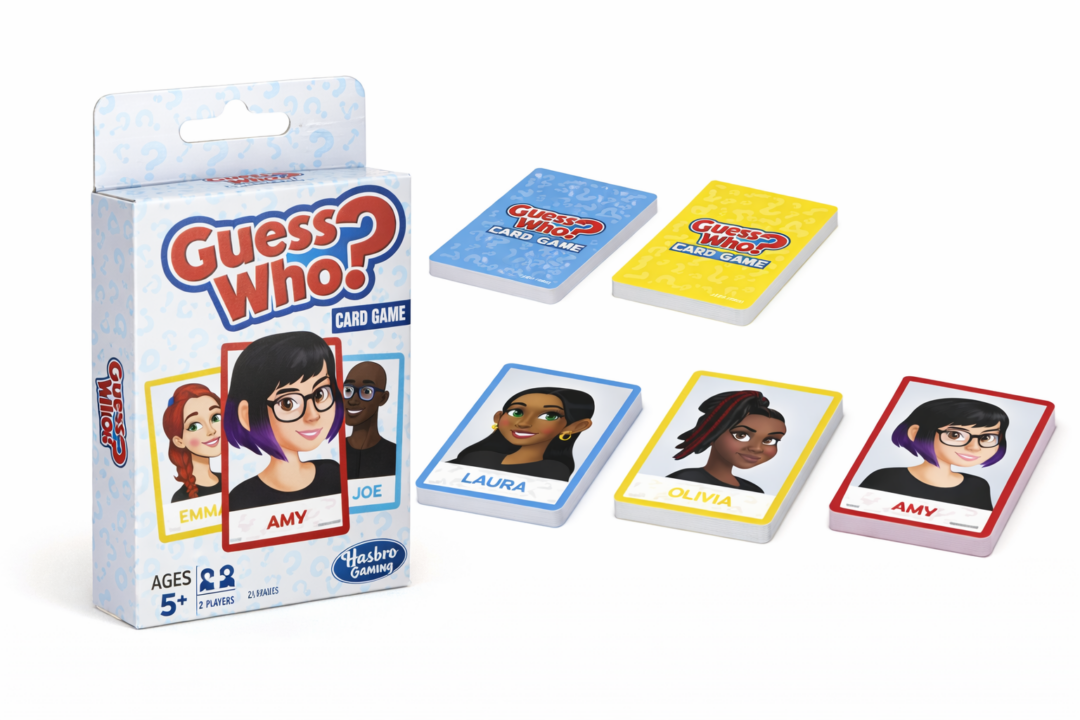
“Guess Who?” is a classic game of deduction and logical reasoning, available in different versions: the classic version with boards, the travel version, and the new “Card Game” version. In this description, I focus on the “Card Game” version, particularly suitable for classroom use due to its practicality and quick setup.
The game mechanism develops various cognitive and linguistic skills: in addition to observation and logical reasoning abilities, students must formulate effective questions, use correct interrogative structures, and develop progressive elimination strategies.
In an educational context, it can be used to practice descriptive vocabulary (especially physical appearance), strengthen listening and question comprehension skills, and enhance logical reasoning in a foreign language.
Adaptation to Educational Context:
The game is useful for foreign language teaching for:
Practicing Descriptive Vocabulary – The game forces students to use vocabulary related to physical characteristics, accessories, and colors. It is an ideal tool for practicing physical appearance description in a dynamic and engaging way.
Practicing Interrogative Structures – Students practice the correct formulation of closed questions (yes/no) and tag questions.
Development of Logical Reasoning in L2 – Students must process information, eliminate possibilities, and formulate hypotheses entirely in the target language. This develops the ability to think directly in L2.
Active Listening Practice – Players must listen carefully to the opponent’s questions to give the correct answer (“yes” or “no”). This develops oral comprehension skills in an authentic and dynamic context.
Language Practice:
Vocabulary: Physical characteristics (hair, eyes, face), colors, sizes (tall/short, big/small), accessories (hat, glasses), qualifying adjectives.
Conversation: Formulation of closed questions, short answers (yes/no), oral comprehension.
Grammar: Interrogative structures (closed questions and tag questions).
Tips for Adapting to Class Level and Lesson Needs:
– The game is particularly useful for practicing physical description vocabulary. For lower levels, prepare a written list of useful adjectives and structures to keep visible during the game: hair colors (blonde, brown, black, red, gray), eye colors (blue, green, brown), characteristics (glasses, beard, mustache) and allow students to consult the vocabulary list during the game.
– To increase the number of questions and prolong the game: modify the elimination rule. Instead of flipping all characters that don’t match the answer, students can eliminate only one character at a time. This forces them to ask many more questions and practice the language more.
– Introduce a post-game reflection phase where students analyze the strategies used and the most effective questions, thus consolidating metalinguistic learning.
– Students can play in pairs (each pair receives a set of cards and plays independently) or in teams (with 2-3 people in a team).
Examples of Use in CLIL and Other Subjects:
The added value of using “Guess Who?” in CLIL contexts is that students:
1. Practice specialized subject vocabulary through targeted questions
2. Develop the ability to categorize and classify disciplinary elements
3. Reinforce basic knowledge in an interactive and memorable way
4. Use interrogative structures in authentic contexts related to the discipline
How to Use the Game in CLIL:
The mechanics of “Guess Who?” can be easily adapted to any subject by replacing characters with disciplinary elements. Teachers can create personalized cards with images and characteristics relevant to the study topic.
For CLIL subjects, it is recommended to create thematic card sets where each “character” represents an element of the discipline with specific characteristics.
Literature
Cards with names of characters from one or more novels studied in class. Students must guess the character by asking questions about their characteristics, actions, relationships with other characters.
Question examples: “The Picture of Dorian Gray” by Oscar Wilde
– Is this character an artist?
– Does this character influence Dorian negatively?
– Is this character in love with Dorian?
Art History
Cards with reproductions of famous artworks. Students must guess the work by asking questions about style, author, period, predominant colors, subjects represented.
Question examples:
– Is this artwork from the Renaissance?
– Is the artist American?
– Are there human figures in the artwork?
– Is it a portrait?
Geography
Cards with images and names of countries or flags. Students must guess by asking questions about continents, territorial characteristics (mountains, rivers, seas), climate, population, main resources.
Question examples:
– Is this country located in Europe?
– Does it have access to the ocean?
– Are there mountains in this country?
Science
Cards with images of animals or plants. Students ask questions about characteristics: class (mammal, reptile, bird, etc.), habitat, diet, distinctive physical features.
Question examples for animals:
– Is it a mammal?
– Does it live in water?
– Does it have feathers?
– Can it fly?